AI workbench for client data onboarding. Built for implementation teams at vertical SaaS.
Book WalkthroughNewsletter
Get the latest updates on product features and implementation best practices.
AI workbench for client data onboarding. Built for implementation teams at vertical SaaS.
Book WalkthroughNewsletter
Get the latest updates on product features and implementation best practices.

It’s a scene that plays out in countless software companies: a new client is ready to onboard, but their data is a mess. The implementation specialist hits a wall and the task gets escalated. Soon, your most expensive senior developer—the one who should be building your next core feature—is knee-deep in a spreadsheet, wrestling with inconsistent date formats and writing a one-off script to clean it.
The file gets cleaned. The client gets onboarded. The problem is solved, right?
Wrong. This isn't a technical problem; it's a business bottleneck with steep, hidden costs. When your engineering team becomes the default data cleaning department, you're not just misusing their time; you're slowing your entire company down.
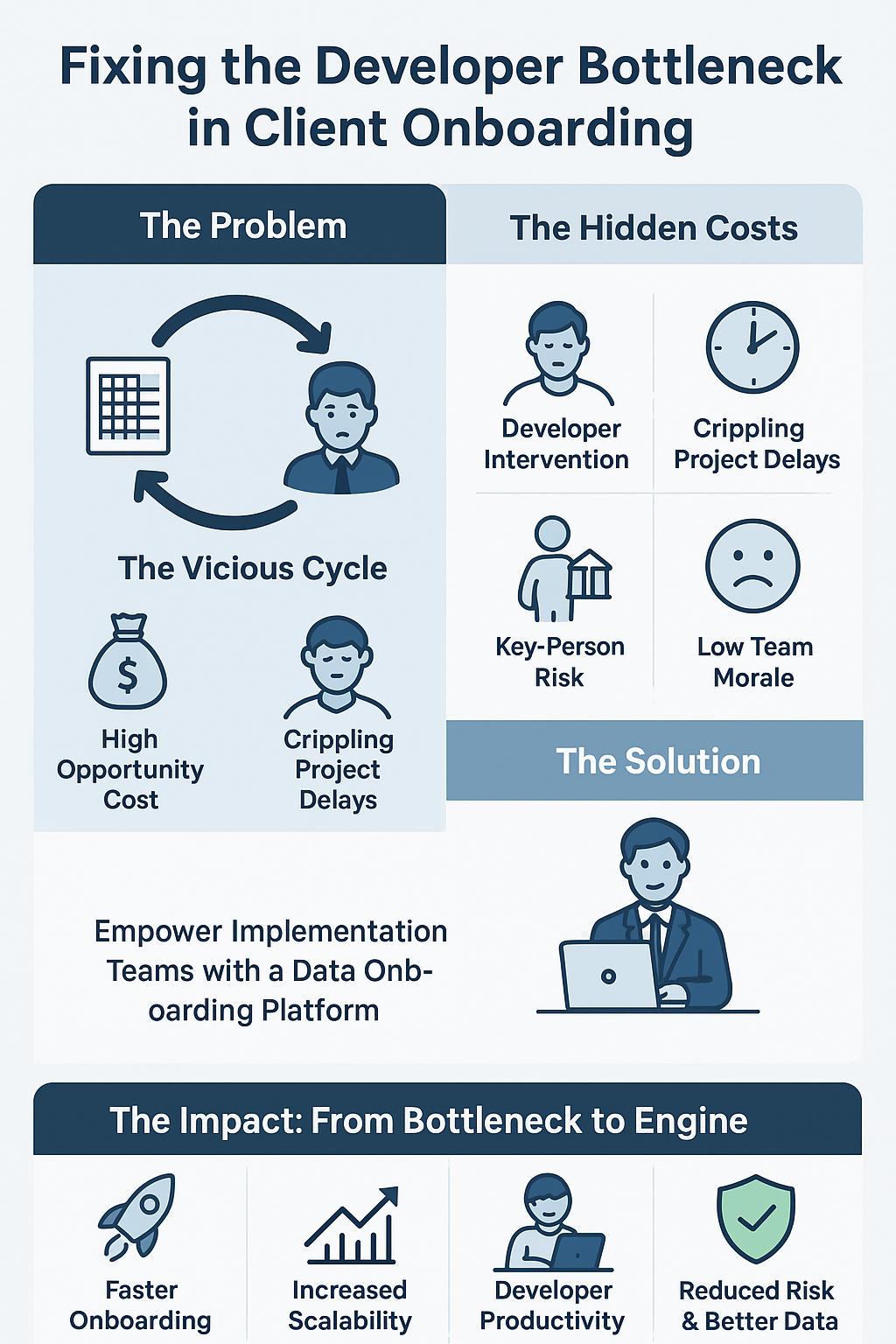
Viewing data preparation as "just a developer task" creates a cascade of inefficiencies that impact your bottom line, your team's morale, and your clients' happiness.
This cycle isn't scalable. To grow, you need to break the bottleneck.
The answer isn't to hire more developers to clean more files. The answer is to empower your implementation and data analyst teams—the people who understand the client's data best—with tools that allow them to handle complex data preparation themselves.
This is about shifting the work to the right resources. By providing a powerful, no-code/low-code data transformation platform, you can turn your implementation team into a self-sufficient data onboarding engine.
By providing a powerful, no-code/low-code data transformation platform, you can turn your implementation team into a self-sufficient data onboarding engine.
When you empower your implementation team, the benefits extend far beyond just saving developer time.
Treating data preparation as a developer-only task is a strategic error, not a workflow necessity. By investing in the right tools, you can transform this bottleneck into a source of competitive advantage.
Empowering your implementation team isn't just about buying software; it's a strategic decision to optimize your entire team's output, reduce operational risk, and deliver value to your customers faster. Stop wasting your best engineering talent on spreadsheets and start building a truly scalable onboarding process.
 DataFlowMapper
Ready to eliminate onboarding headaches & secure your spot?
The opposite is true with the right platform. A controlled environment with features like proactive validation, clear error reporting, and reusable, pre-approved templates actually *reduces* risk. It formalizes the process, moving it out of fragile, one-off scripts and into a manageable, auditable workflow.
Consider the total cost of ownership. Scripts require ongoing maintenance, are often understood by only one person (key-person risk), and create a bottleneck every time a new client's data has a slightly different format. A dedicated platform pays for itself by eliminating maintenance overhead, speeding up every subsequent onboarding, and freeing up that developer's time for revenue-generating work.
It accelerates the process by removing the primary delay: the back-and-forth between the implementation team and developers. When the analyst who understands the client's data can directly configure the transformation and validation rules, the iteration cycle shrinks from days to hours. This dramatically shortens the time from receiving a client's file to having clean, ready-to-import data.