
AI workbench for client data onboarding. Built for implementation teams at vertical SaaS.
Book WalkthroughNewsletter
Get the latest updates on product features and implementation best practices.
AI workbench for client data onboarding. Built for implementation teams at vertical SaaS.
Book WalkthroughNewsletter
Get the latest updates on product features and implementation best practices.
Customer onboarding: it's the critical first handshake between your software and your client's reality. Get it right, and you pave the way for rapid adoption, trust, and long-term success. Get it wrong, especially when wrangling data from ubiquitous CSV and Excel files, and you risk operational chaos, frustrated users, delayed revenue, and eroded confidence.
While basic data validation guides might cover checking if a field contains a number or if an email looks like an email, that's merely scratching the surface. For implementation specialists, data migration teams, and onboarding analysts navigating the complexities of real-world customer data, true mastery demands going far beyond simple checkboxes. It means confronting intricate business rules, overcoming the inherent limitations of spreadsheets, and leveraging modern techniques, including AI, to ensure data isn't just present, but correct, consistent, and meaningful within the context of your system.
If you're wrestling with data that looks "valid" but breaks processes downstream, or if the cycle of manual error correction in spreadsheets is crippling your onboarding timelines, this guide is for you. Understanding how to handle data validation in software effectively, especially when dealing with flexible formats and complex business requirements, is crucial for smooth implementations. We'll dive deep into how to validate data and advanced data validation strategies tailored for customer onboarding involving CSV, Excel, and JSON data, exploring:
CSV and Excel are the lingua franca of data exchange: simple, accessible, and universally understood. But this very flexibility is their Achilles' heel during data onboarding:
Relying only on basic format or type checks in this environment is like checking if puzzle pieces are square without seeing if they form the correct picture. The data might pass superficial checks but remain functionally useless or even harmful once loaded.
The most critical gap in basic validation is its inability to verify data against your specific business logic. Your system doesn't just need a date; it needs an order date that occurs after the account activation date. It doesn't just need a transaction code; it needs a code that's valid for that specific client's service tier and geographic region.
This is where Business Rule Validation comes in. It ensures data makes sense within the operational context of your software. Examples are numerous and vital:
Ignoring business rule validation means allowing functionally incorrect data into your system, leading to flawed reports, broken workflows, compliance failures, and ultimately, a poor customer experience.
A robust strategy layers multiple validation techniques. While foundational checks are necessary, advanced methods tackle the deeper complexities:
Foundation Checks (The Basics):
Advanced Techniques (Essential for Complex Onboarding):
def validate_order_discount(record):
    if record['ClientTier'] == 'Premium' and record['OrderValue'] > 5000:
        if record['DiscountPercentage'] > 0.20:
            return False, "Premium clients max discount is 20% on orders over $5000"
    # ... other checks ...
    return True, ""
Layering these techniques provides a comprehensive defense against the diverse data quality issues encountered during onboarding and can serve as fundamental rules of data validation.
Validating a single import is one thing; validating a full data migration is another. A migration moves a whole body of records from a legacy system into a new one, and the demand searchers express here (data migration validation, how to validate data after migration, migration validation) comes down to two checkpoints: catching errors before the data lands, and proving the data is correct after it does.
Pre-load validation runs while the data is still a file or a staging set, where errors are cheap to fix:
Post-load validation runs after the data is in the target system, where the goal shifts from "is it well-formed" to "did it land correctly":
Use this as a repeatable, copyable checklist for any file-based migration:
A free CSV validator handles quick structural checks on a single file; full migrations and recurring imports need rule-based, referential, and reconciliation checks that run the same way every time.
For teams that receive files on a recurring basis (client uploads, partner feeds, periodic exports), the real question is not how to validate one file but how to automate data validation checks for incoming files so every upload is checked the same way without manual effort.
The pattern that scales is template-driven validation:
This is the difference between validation as a one-off chore and validation as a repeatable system. Automated, template-based validation is what makes recurring onboarding sustainable: the rules are written once, run identically every time, and improve as you encounter new edge cases.
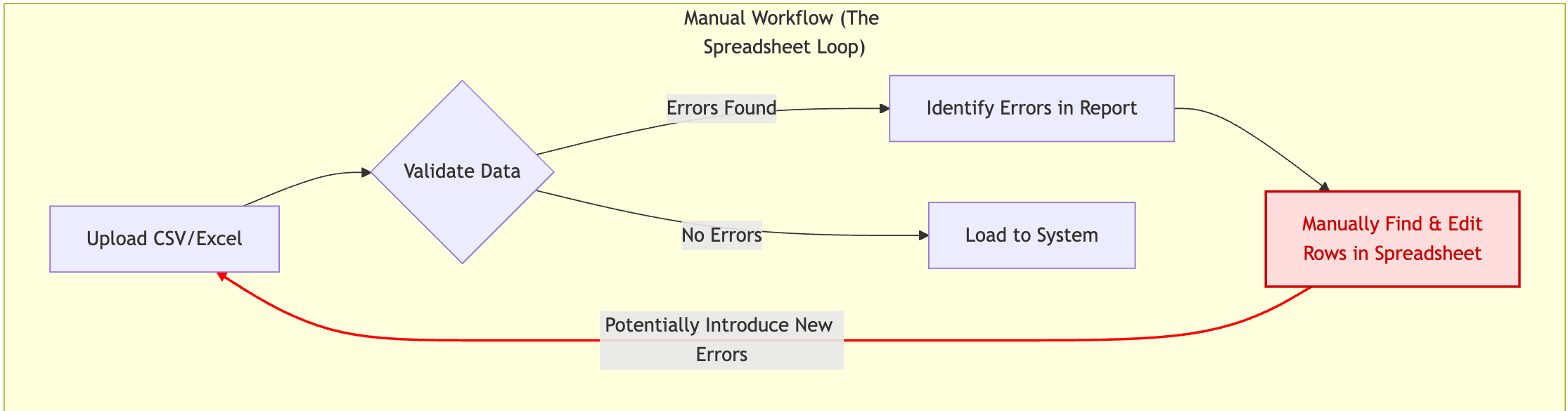
Finding errors is only half the battle. How you handle them determines whether onboarding is smooth or a nightmare. The traditional "find errors -> manually edit Excel -> re-upload -> re-validate" cycle is notoriously inefficient and error-prone.
The Manual Re-processing Nightmare: Imagine finding 100 validation errors scattered across a 50,000-row spreadsheet. Correcting these manually in Excel is tedious, risks introducing new errors (typos, accidentally changing other cells), lacks an audit trail, and offers no guarantee the same mistake won't happen on the next upload. It's a major bottleneck.
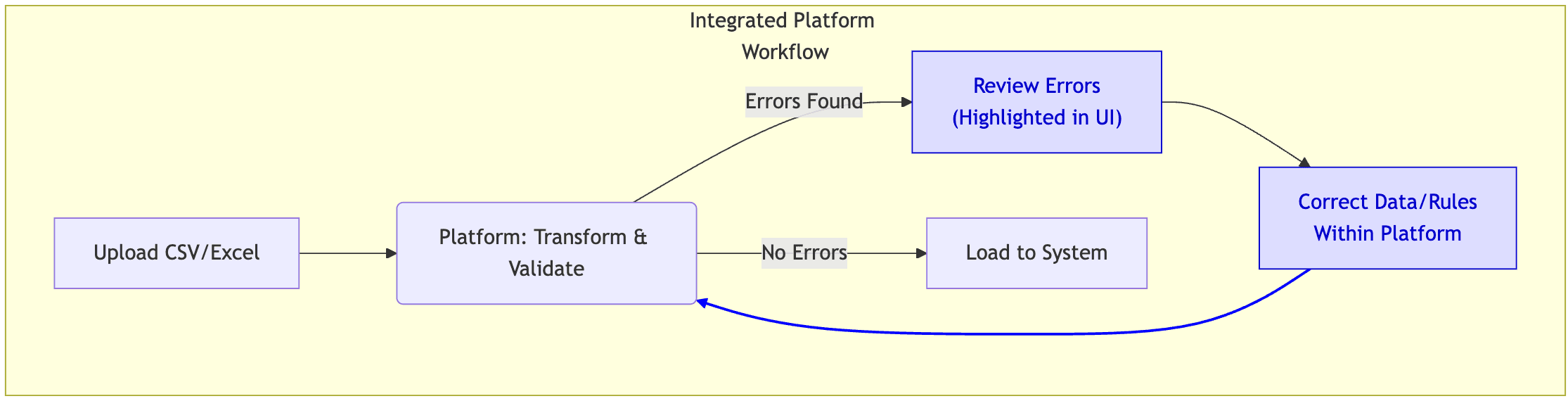
A Better Way: Integrated Remediation & Re-processing:
Artificial Intelligence is emerging as a powerful ally, augmenting human expertise to make data validation more intelligent and efficient.
It's also important to recognize that AI's role often starts even before validation. Sophisticated AI data mapping capabilities in modern platforms can analyze source fields, target schemas, and data values to automatically suggest or perform initial field mappings and even analyze data for anomalies, dramatically accelerating the setup phase before validation rules are even applied.
Crucial Context: AI is a co-pilot, not the pilot. Human oversight remains essential to review AI suggestions, confirm their business relevance, handle nuanced exceptions, and ensure alignment with specific organizational policies. The goal is AI-assisted validation, leveraging its power to accelerate tasks traditionally done by experts.
Building a reliable data validation framework isn't a one-off task; it's a strategic commitment. The following data validation best practices outline the core elements of an effective data validation process and the key steps to ensure data quality during onboarding and data migration:
Mastering data validation is fundamental to successful data onboarding, especially when dealing with challenging formats like CSV and Excel. Having a framework and data validation plan is far more than a technical necessity, it's a strategic advantage. It requires moving beyond superficial checks to embrace the complexities of business logic, leveraging advanced techniques like remote lookups, and designing efficient, repeatable workflows for error remediation.
By strategically incorporating automation and AI assistance, organizations can transform this critical process. Investing in a robust, intelligent data validation framework minimizes costly errors, accelerates customer time-to-value, reduces operational friction, builds foundational trust, and ultimately turns onboarding from a potential minefield into a smooth pathway for long-term customer success.
Data validation in a migration is the process of confirming that data is correct, complete, and consistent both before and after it moves into the target system. It goes beyond format checks to enforce business rules like cross-field consistency, conditional requirements, and relational integrity, and to reconcile the migrated data against the source so errors are caught instead of silently loaded.
Post-migration validation reconciles the loaded data against the source. Compare row and record counts, check control totals and key aggregates, spot-check a representative sample of records field by field, and re-run your business-rule checks against the target system. Anything that fails reconciliation is corrected and re-validated through the same pipeline before sign-off.
Pre-load validation runs before data enters the target system and catches type, format, completeness, referential-integrity, and business-rule errors while they are still cheap to fix. Post-load validation runs after the data is loaded: it reconciles counts and totals, spot-checks records, and confirms the data behaves correctly in the live system. Robust migrations use both.
Define your validation rules once as a reusable template, then apply that template to every incoming file automatically. The system parses the file, runs type, format, referential, and business-rule checks, flags failing rows with clear messages, and lets you correct and re-process through the same pipeline. This replaces manual, per-file spreadsheet checking and keeps validation consistent across recurring uploads.
It is a repeatable list of checks run before and after a migration. Pre-load: source profiling, schema and data-type validation, referential integrity against the target, and required-field completeness. Post-load: row-count reconciliation, control-total comparison, sample spot-checks, and stakeholder sign-off. The checklist in this guide walks through each step.
Teams use a mix: spreadsheets and manual checks for the simplest cases, custom scripts for one-off logic, and dedicated data onboarding or validation platforms for recurring, rule-heavy work. The right tool supports referential lookups against live systems, reusable rule templates, clear row-level error reporting, and re-processing through the same pipeline. Standalone CSV validator tools cover quick structural checks on a single file.