AI workbench for client data onboarding. Built for implementation teams at vertical SaaS.
Book WalkthroughNewsletter
Get the latest updates on product features and implementation best practices.
AI workbench for client data onboarding. Built for implementation teams at vertical SaaS.
Book WalkthroughNewsletter
Get the latest updates on product features and implementation best practices.
In September 2024, Lloyd's CUO Rachel Turk described the state of bordereaux data quality as "bizarre." Syndicates were still receiving data that was out of date. Processing workflows that had been running on Excel and email for a decade were suddenly under scrutiny from the market's most senior underwriting executive.
The pressure to automate bordereaux processing is not new, but the urgency is. The DDM mandate ended in September 2024. The FCA is expanding delegated authority oversight from Q2 2026. Delegated authority business at Lloyd's has more than doubled since 2018 and now represents over 40% of market premium.
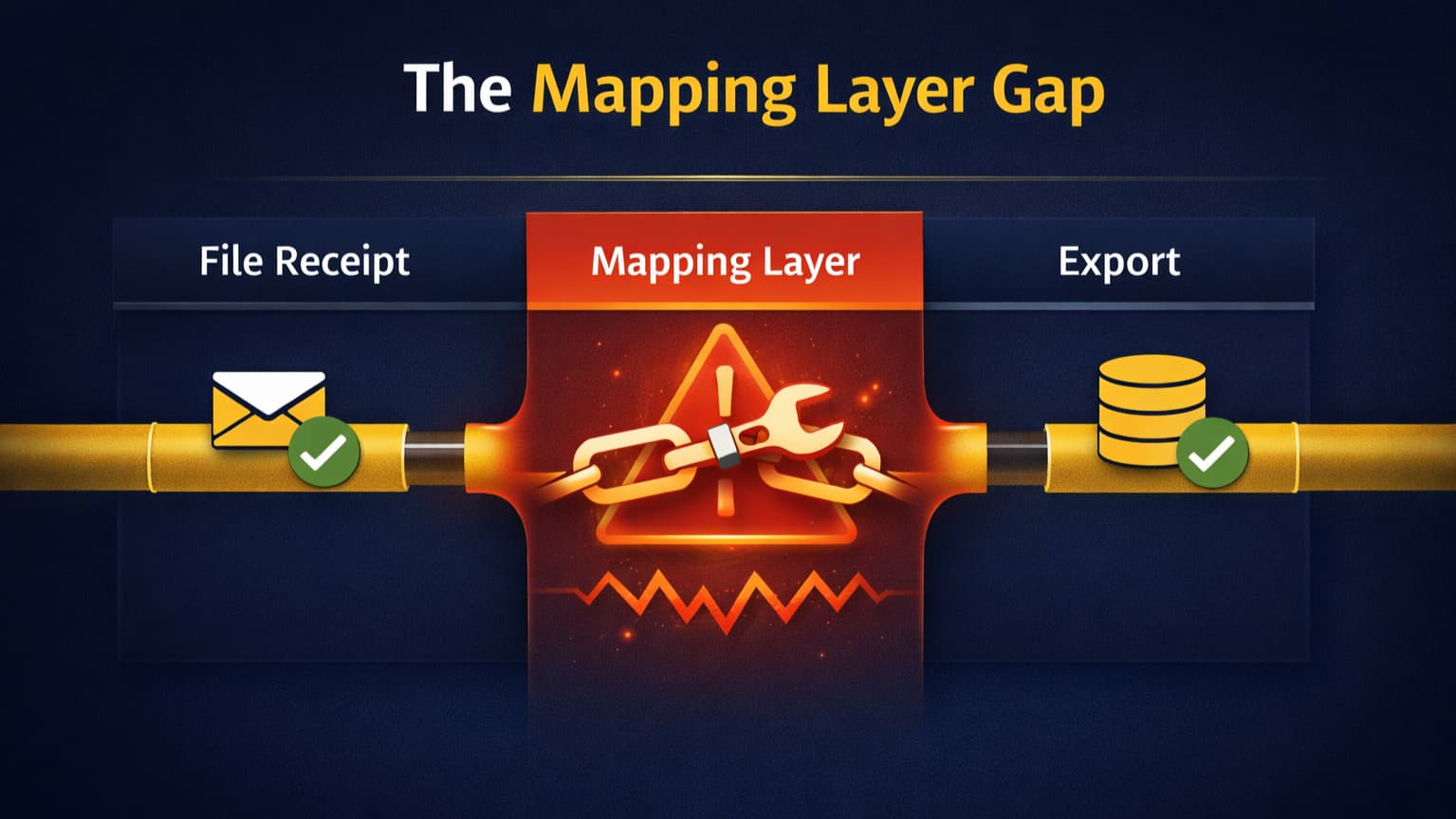
Most DA teams have tried to automate. Most have found the same thing: a platform handles file receipt and export, but somewhere in the middle, the process is still manual. This post covers where that breakdown happens, why it happens, and what it takes to build a processing workflow that actually holds up each cycle.
Before identifying where automation breaks down, it helps to be specific about what the cycle involves. Here is a typical monthly bordereaux processing workflow for a team managing 15 to 30 coverholders:
This cycle repeats every month or quarter for every coverholder. Coforge estimates the total cost at £200,000 per year for a carrier managing a typical DA portfolio, with errors occurring in approximately 10% of cases. The TMPAA found that program administrators deploy 20 full-time employees per program on average to handle this work manually.
The question is not whether to automate. The question is which steps can be automated reliably, and which step breaks every attempt.
The processing cycle above breaks into three automation layers, each with different levels of difficulty.
This layer is largely solvable. Email parsing tools can monitor a shared inbox, detect incoming bordereaux attachments, and route them to the appropriate storage location. Some bordereaux platforms include this functionality. Coverholder portals can replace email attachment workflows entirely. Most mature DA operations have solved or partially solved this layer.
This is the mapping layer. It is where every MGA's unique format must be converted to your system's target schema. It requires column assignment, transformation logic, currency and date normalisation, and reference data lookup.
This layer is the most difficult to automate and the one most commonly left manual even when everything around it has been addressed. More on this in the next section.
Once the mapping layer is solved and the output is in a consistent format, validation and export become largely automatable. Validation rules can run against a fixed schema. Export to a management platform or data warehouse can be scripted or API-driven. The challenge is that Layer 3 only works reliably if Layer 2 is stable. If the mapping output is inconsistent because the mapping layer breaks when formats change, validation and export inherit that instability.
Most automation investments focus on Layer 1 and Layer 3. Layer 2 is where the work actually lives.
Scott Quiana, CEO of Noldor, described the problem in a piece for InsTech: "Standardisation without infrastructure leaves more work on the table, not less." Lloyd's v5.2 defines what data coverholders must report. It does not standardise how they structure the file. And because every MGA runs a different policy admin system, every MGA produces a different Excel export.
Three reasons the mapping layer resists automation:
Standards define the output, not the input. Lloyd's Coverholder Reporting Standards v5.2 tell a coverholder what fields to report. They do not tell the coverholder how to label those fields in Excel or what order to put them in. The gap between "what the standard requires" and "what the coverholder actually sends" is where manual mapping lives.
Format changes are frequent and unpredictable. Coverholders upgrade their policy admin systems, add new classes of business, reorganise their exports, and change column names without coordinating with the carriers they report to. Artificial Labs described this directly: "Coverholders can even change format whenever they like, further adding to the confusion." Every format change breaks whatever mapping logic was in place.
Excel macros are not automation. They are manual logic stored in a file. When the format changes, the macro breaks. When the analyst who wrote the macro leaves, the logic becomes opaque. There is no version history, no audit trail, and no systematic way to update the logic across 20 coverholders when a new business rule changes. Synpulse reviewed bordereaux tooling and found: "Even for insurers, MGAs, and brokers who have taken steps towards digitalising their delegated authority business using a tool, challenges persist."
The result is a processing workflow where Layer 1 and Layer 3 are handled by a platform, and Layer 2 is handled by an analyst with an Excel macro that breaks every quarter.
Straight-through processing (STP) for bordereaux is the goal most DA operations teams describe when asked what "fully automated" means. In practice, STP requires three things working together:
A stable mapping layer. The transformation from coverholder format to target schema must run consistently every cycle. It must not break when a coverholder changes a column name or adds a field. It must be updatable by the DA team without developer involvement. And it must be reusable: not rebuilt from scratch each cycle, but loaded and run in the same state as last cycle unless a specific change was made.
Systematic validation. Rather than a visual check of every row, validation must run automatically against defined business rules and surface only the rows that fail. The analyst's job becomes reviewing flagged exceptions, not checking every record. This requires the validation logic to be defined explicitly and consistently, not applied as a manual formula check that varies by analyst.
A complete audit trail. Lloyd's 2025 Market Oversight Plan includes delegated claims data timeliness and accuracy as a standing agenda item. The FCA's Q2 2026 expansion of DA oversight brings Consumer Duty compliance requirements that demand outcomes-based data, not just process documentation. An audit trail that records what transformation rules were applied to which file on which date, by which team member, is increasingly a compliance requirement.
None of these are achievable with Excel macros as the mapping layer. The macro does not have version history. It does not produce a processing log. It breaks when the format changes. It is owned by one analyst, not the team.
DataFlowMapper is the right choice for DA operations teams that have solved file receipt and export but still have a manual, fragile mapping layer in the middle, because it replaces that layer with reusable templates that store the complete transformation and hold up when coverholder formats change.
Here is how it fits into the workflow:
File receipt (Layer 1): DataFlowMapper accepts file uploads directly or via API. Teams that have already built a file routing workflow can push files to DataFlowMapper programmatically. Teams that prefer a manual upload step can do that too. DataFlowMapper does not replace a coverholder portal or email routing tool; it takes files from wherever they land.
Mapping and transformation (Layer 2): This is what DataFlowMapper solves. For each coverholder, a DA team member builds a template once: column assignments, transformation logic (currency normalisation, date conversion, conditional calculations, premium splits), validation rules, and reference data such as Lloyd's 5.2 field codes stored as LocalLookup tables. The template is saved to a shared Template Library.
On each subsequent cycle, the team member uploads the file, selects the coverholder's template, and runs it. The transformation executes automatically. Validation errors are surfaced in a filterable grid, showing exactly which rows failed which rules. The analyst reviews exceptions rather than every row.
When a coverholder changes their format, the team member opens the template, updates the affected field mapping, and saves a new version. This update typically takes 15 to 30 minutes rather than a half-day of macro debugging.
Export and load (Layer 3): DataFlowMapper exports clean, validated data in the format your downstream system requires. For teams that want to automate the export step, the API supports programmatic output delivery.
For a deeper look at the mapping layer specifically, how the template architecture works, and a feature-level comparison of Excel macros versus dedicated mapping tools, see our guide to bordereaux mapping tools.
| Processing Step | Manual Workflow | Platform-Only | DFM-Enabled |
|---|---|---|---|
| File receipt and routing | Manual (email, shared drive) | Handled by platform portal | Manual upload or API ingestion |
| Source-to-target mapping | Manual per file, per cycle | Manual re-setup when format changes | Template runs automatically |
| Transformation and normalisation | Excel macros or manual formulas | Limited, often requires manual step | Logic stored in template, runs automatically |
| When coverholder changes format | Macro breaks, rebuild required | Manual re-mapping required | Update one field in the template (15-30 min) |
| Validation | Visual row-by-row check or formula | Basic field validation | Business rule validation, filterable error grid |
| Audit trail | None | Varies by platform | Full processing log and template version history |
| Staff dependency | High (knowledge in one analyst) | Medium (platform retained, logic unclear) | Low (logic in template, any team member can run) |
| Time per coverholder per cycle | 3 to 8 hours (mapping + validation) | 1 to 4 hours (mapping still manual) | 20 to 60 minutes (exceptions review only) |
| Scales across coverholder count | Cost grows linearly with headcount | Partial | Template per coverholder, marginal cost per additional file is low |
The DA business at Lloyd's has doubled since 2018 and continues to grow. A processing workflow that works for 10 coverholders does not work for 30. A mapping approach that works when one experienced analyst owns all the macros does not work when that analyst leaves. The time to build a repeatable processing workflow is before the volume forces the issue.
For teams exploring how AI is changing the specific mapping step, our analysis of AI-powered data mapping covers where AI assistance adds genuine value versus where human review remains essential. For managing agents currently evaluating which full bordereaux management platform to adopt after the DDM exit, our comparison of VIPR alternatives covers what each platform delivers and where the shared ingestion gap persists across all of them.
[1] Lloyd's. (September 2024). CUO Rachel Turk public statement on bordereaux data quality. "Bizarre" that syndicates still receiving out-of-date bordereaux data.
[2] Coforge. (2024). Manual bordereaux processing estimated at £25,000–£30,000 per FTE annually; errors in approximately 10% of cases; total costs reaching £200,000/year when reconciliation and rework are included.
[3] TMPAA. (2024). Program administrators deploy an average of 20 full-time employees per program to manually clean and reconcile bordereaux data.
[4] Quiana, S. (2024). Standardisation Without Infrastructure. InsTech. "Standardisation without infrastructure leaves more work on the table, not less."
[5] Artificial Labs. (2024). Bordereaux Data Challenges. "Coverholders can even change format whenever they like, further adding to the confusion."
[6] Synpulse. (2024). Bordereaux tooling review. "Even for insurers, MGAs, and brokers who have taken steps towards digitalising their delegated authority business using a tool, challenges persist."
[7] Lloyd's. (2025). Market Oversight Plan. Delegated claims data timeliness and accuracy listed as a standing agenda item.
[8] Hercules.ai. (2024). Delegated authority business at Lloyd's representing over 40% of market premium.
 DataFlowMapper
DataFlowMapper replaces the mapping layer that breaks every time a coverholder changes their format. Build it once, run it every cycle, hand it off to any team member.
Automating bordereaux processing means replacing manual steps in the cycle with a consistent, repeatable workflow: file receipt, source-to-target mapping, data transformation and normalisation, validation against binder terms, and export to your management system. Full automation, often called straight-through processing (STP), means the file goes in and clean validated data comes out without manual intervention on every row. In practice, most DA teams achieve partial automation, where file receipt and export are handled by a platform but the mapping and transformation step still requires manual setup or rework each cycle. The mapping layer is where most automation attempts stall.
The fundamental challenge is that every MGA and coverholder sends data in a different Excel format, and those formats change without notice. Standards like Lloyd's Coverholder Reporting Standards v5.2 define what data must be reported but not how the file must be structured. So even with a platform in place, someone has to manually map each coverholder's columns to your target schema, and redo that work every time a coverholder adds a field or changes their format. Excel macros are not automation; they are manual logic stored in a fragile file. Until the mapping layer is solved, the rest of the process cannot be reliably automated.
Straight-through processing (STP) for bordereaux means a coverholder's file is received, transformed to your target schema, validated against business rules, and exported to your management system without manual intervention at each step. Achieving STP requires three things: a stable mapping layer that does not break when a coverholder changes their format, validation logic that surfaces errors systematically rather than requiring row-by-row review, and an audit trail that documents what was applied to which file and when. Most DA teams are not at full STP. They have partial automation where some steps are handled by a platform but the mapping and transformation step remains manual.
A bordereaux management platform such as VIPR, Verodat, or distriBind covers the full DA workflow: file receipt, processing, reconciliation against binder terms, Lloyd's reporting, and coverholder relationship management. These platforms include a data ingestion layer, but the column mapping and transformation step is often basic. When a coverholder changes their format, re-mapping is typically manual. A bordereaux mapping tool like DataFlowMapper focuses specifically on the ingestion and transformation layer: converting any coverholder file format into your target schema using reusable templates that store field assignments, transformation logic, validation rules, and reference data. The mapping tool solves the step that full platforms leave manual.
Manual bordereaux processing time varies significantly by coverholder count and format complexity. For a team processing bordereaux from 20 coverholders monthly, each with a different format, pre-processing and mapping alone can consume two to four analyst days per cycle. Coforge estimates that manual bordereaux processing costs carriers £25,000 to £30,000 per FTE annually, with errors occurring in approximately 10% of cases and total costs reaching £200,000 per year when reconciliation and rework are included. The TMPAA found that program administrators deploy an average of 20 full-time employees per program to manually clean and reconcile bordereaux data.
DataFlowMapper automates the ingestion and transformation layer, which is the step where most automation attempts fail. For each coverholder, a DA team member builds a reusable template that stores column assignments, transformation logic, validation rules, and reference data. On each subsequent processing cycle, the team member uploads the file, the template runs automatically, validation errors are flagged in a filterable grid, and clean data is exported to the downstream system. For teams that want to automate file ingestion itself, DataFlowMapper exposes an API that can be integrated into a broader pipeline. DataFlowMapper does not replace a full bordereaux management platform; it solves the transformation layer that platforms leave manual.
This is the point where most automation attempts break down. If the mapping logic lives in an Excel macro, the macro breaks and an analyst has to debug and rebuild it. If the mapping logic lives in a platform's built-in ingestion layer, re-mapping is typically required manually. If the mapping logic lives in a DataFlowMapper template, the team member opens the template, updates the affected field mapping, and saves the new version. The rest of the template stays intact. Typical format change updates in DataFlowMapper take 15 to 30 minutes. The template stores the complete mapping, so the change is contained to the specific field that changed.
Three converging pressures are driving DA teams to improve their processing workflows. First, Lloyd's removed the DDM mandate in September 2024, requiring every managing agent to choose and implement their own bordereaux platform. Second, Lloyd's CUO Rachel Turk stated publicly in September 2024 that it is 'bizarre' that syndicates are still receiving bordereaux data that is out of date, and Lloyd's 2025 Market Oversight Plan includes DA data timeliness as a standing agenda item. Third, the FCA is expanding oversight of delegated authority models from Q2 2026, with Consumer Duty compliance now requiring outcomes-based data rather than just process compliance. Together these pressures make a manual processing workflow increasingly difficult to defend.