AI workbench for client data onboarding. Built for implementation teams at vertical SaaS.
Book WalkthroughNewsletter
Get the latest updates on product features and implementation best practices.
AI workbench for client data onboarding. Built for implementation teams at vertical SaaS.
Book WalkthroughNewsletter
Get the latest updates on product features and implementation best practices.
In September 2024, Lloyd's removed the mandatory status of the Delegated Data Manager (DDM). The directive had required every Lloyd's managing agent to process bordereaux through a single centrally-managed platform. When that requirement ended, nearly every managing agent stepped away from DDM and began evaluating their own tooling.
VIPR is the obvious starting point for any comparison. It holds over 50% of the Lloyd's managing agent market and processes an estimated 375,000 to 400,000 bordereaux per year. Any VIPR alternatives evaluation begins there.
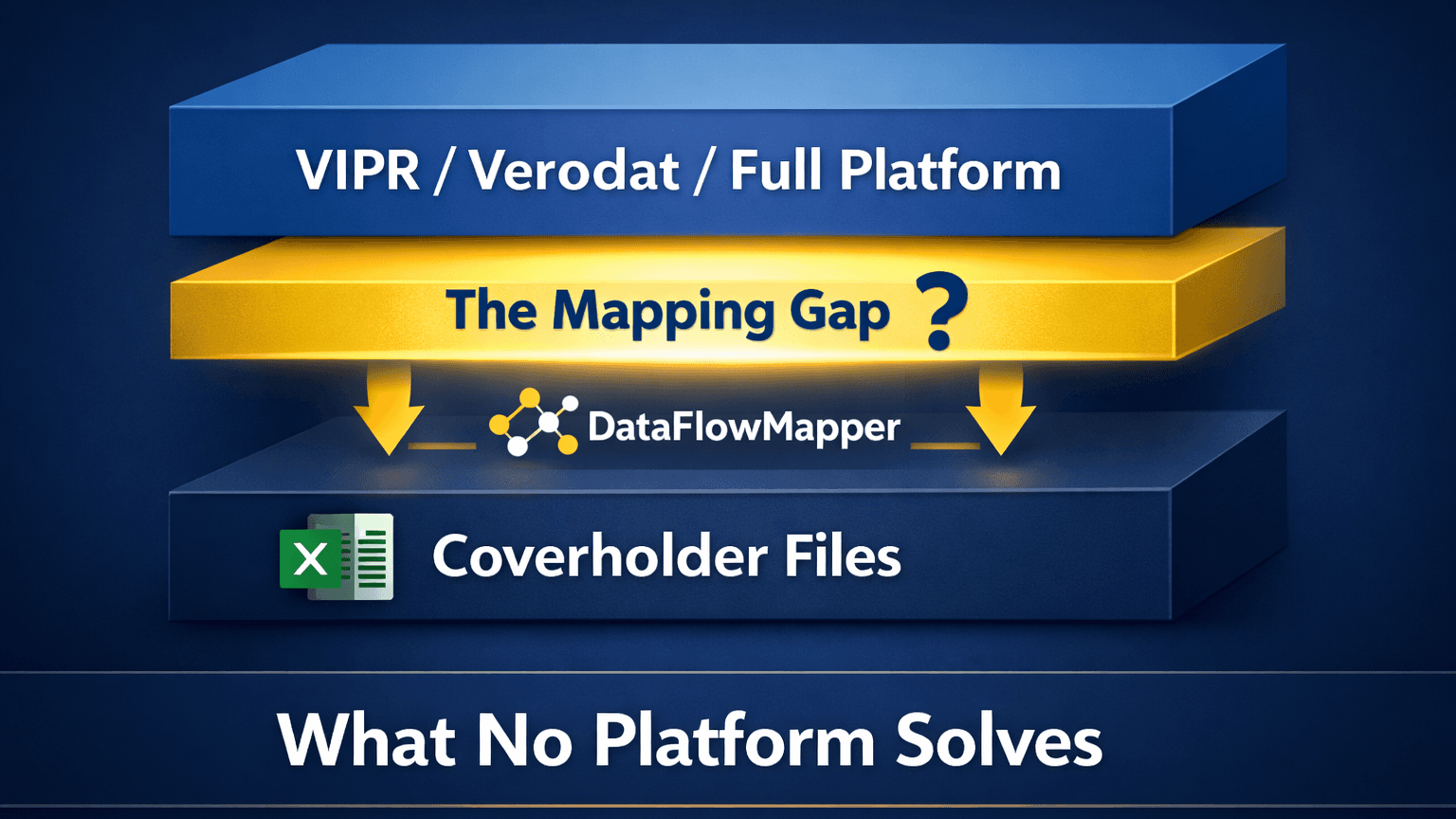
But this post covers something most platform comparisons skip: the step that every full bordereaux management platform assumes you have already solved. That assumption is wrong for most DA operations teams, and it is where the manual work in your monthly cycle actually lives.
Three things converged in late 2024 and early 2025 that made platform selection urgent rather than optional.
The DDM mandate ended. In September 2024, Lloyd's made DDM elective. Every managing agent that had relied on it for centralised processing now needs its own approach. VIPR's CEO said at the time that "all bar about six managing agents have stepped away from DDM." That procurement activity is visible in hiring: Gallagher Re implementing VIPR Intrali, AXIS Capital in transition, and multiple Lloyd's market firms advertising senior bordereaux and DA technology roles at salaries up to £100,000.
Lloyd's CUO called the status quo unacceptable. In September 2024, Rachel Turk, Lloyd's Chief Underwriting Officer, described it as "bizarre" that syndicates were still receiving bordereaux data that was out of date in 2024. Lloyd's 2025 Market Oversight Plan now includes delegated claims data timeliness and accuracy as a standing agenda item. DA teams that cannot demonstrate timely, accurate processing are under direct scrutiny.
The FCA is expanding oversight. From Q2 2026, the FCA is expanding oversight of delegated authority models. Consumer Duty compliance now requires outcomes-based data, not just process documentation. An audit trail of what transformation rules were applied to which file and when is increasingly a compliance expectation, not just an operational convenience.
The practical effect: managing agents that deferred the platform decision or tolerated a manual Excel workflow are running out of runway. The procurement cycle is happening now.
Here is an honest assessment of each major platform. The comparison that matters is not just features on paper but what each platform actually delivers for the ingestion and transformation step that sits between incoming coverholder files and your target schema.
VIPR is the market reference point. Over 50% of Lloyd's Managing Agents use it. The platform covers the full DA lifecycle: bordereaux receipt, processing, Lloyd's reporting, binder reconciliation, coverholder relationship management, and performance analytics. VIPR is Tenzing PE-backed, expanded into the US and Australia, and added 15 new customers in 2024.
The full lifecycle coverage is VIPR's strength and its scope. It is a substantial platform commitment with enterprise pricing and an implementation process that fits managing agents who need the end-to-end DA workflow managed in one system.
The ingestion layer works for coverholders with stable, consistent formats. When a coverholder changes their column structure, re-mapping is manual. VIPR's CEO acknowledged in 2024 that Excel-based bordereaux are likely to continue for some time, confirming that the transformation step between incoming files and VIPR's schema still requires ongoing manual attention.
Best fit: Large managing agents or syndicates needing a full DA lifecycle platform with Lloyd's reporting, binder management, and coverholder relationship tracking as primary requirements.
Verodat positions as a data supply chain platform with a focus on AI readiness through its proprietary ADRI (Agent Data Readiness Index) framework. Their bordereaux management offering includes AI-assisted field mapping, validation, and export, with a published case study citing 94% faster processing.
Verodat's entry point is a EUR 15,000 proof-of-concept engagement, which is more accessible than VIPR's enterprise commitment. It is Dublin-based, and insurance is one vertical among several. Verodat is the closest like-for-like alternative to VIPR for managing agents that want a full platform without VIPR's scale and commitment level.
The shared limitation applies here too: when a coverholder changes their file format, re-mapping requires manual setup work. Verodat's ingestion uses AI to suggest field matches, but template management when formats drift is not fully solved.
Best fit: Managing agents and carriers who want a governed data supply chain approach with AI readiness positioning, at a lower initial cost than VIPR.
distriBind takes the most differentiated position in the market. Rather than managing the DA lifecycle for one party, it positions as a digital data exchange between all parties in the value chain. Its stated goal is to eliminate spreadsheet bordereaux entirely.
It is a Lloyd's Lab Cohort 6 graduate with named clients including Liberty Specialty Markets, Allianz, and Coral Insurance, and entered the US market through a Stere partnership. distriBind processes spreadsheets, XML, PDFs via OCR, and JSON via API. Its smart ingestion tool claims to handle inconsistent data labels without manual column mapping.
The practical question for managing agents evaluating distriBind is whether their coverholders will participate. The platform's value increases when the data exchange itself is digitised, not just the processing step on one side. For managing agents whose coverholders will continue sending Excel files indefinitely, the ingestion step still exists and still needs a solution.
Best fit: Managing agents who want to modernise the data exchange relationship with their coverholders across the full value chain, not just process incoming files more efficiently.
Charles Taylor Tide is the technology platform that underpinned the DDM mandate. It remains available as an elective service following the September 2024 removal of the mandate. For managing agents already familiar with Tide through their DDM experience, continuing on it voluntarily is an option.
Charles Taylor also launched Bordereaux Sync in beta in 2025, a separate AI-powered data repair tool for cleansing and repairing faulty bordereaux data before passing it to a counterparty. Bordereaux Sync addresses data quality and repair, not column mapping or schema transformation. It is a different product from Tide.
Best fit: Managing agents that used DDM and want to continue on familiar technology rather than implement a new system.
Quantemplate is worth naming specifically because it is the platform most focused on ML-assisted column mapping, which is the closest positioning to what DataFlowMapper does. It describes its offering as "intuitive tools to rapidly map disparate bordereaux to a common schema, assisted by machine learning," with suggestions that learn from user corrections. It connects to Lloyd's 5.2, Duck Creek, Azure, and data warehouses.
However: Tracxn data as of December 2024 shows only 2 employees at Quantemplate, despite $23.32M in total funding from Anthemis, Allianz X, and Route 66 Ventures. This is a significant signal for any managing agent considering it as a long-term platform. Before including Quantemplate in an active evaluation, confirming its current operational status directly is advisable.
| Platform | Full DA Lifecycle | Primary Positioning | Format Change Handling | Pricing Signal |
|---|---|---|---|---|
| VIPR | Full lifecycle | DA lifecycle management, Lloyd's reporting | Manual re-mapping required | Enterprise, opaque |
| Verodat | Full lifecycle | Governed data supply chain, AI readiness | Manual re-mapping required | EUR 15,000 POC entry point |
| distriBind | Exchange focus | Digital data exchange across the value chain | Smart ingestion; coverholder participation required | Not publicly listed |
| Charles Taylor Tide | Full lifecycle | Former DDM platform, now elective | Manual re-mapping required | Enterprise, opaque |
| Quantemplate | Mapping focus | ML-assisted bordereaux mapping | ML suggestions, learns from corrections | Operational status uncertain (2 employees per Tracxn, Dec 2024) |
Every platform in the table above handles the DA lifecycle well. What none of them fully solve is the column-mapping and transformation step between incoming coverholder files and the platform's target schema.
This is not a gap unique to any one vendor. It is structural. Lloyd's Coverholder Reporting Standards v5.2 define what data coverholders must report. They do not standardise how coverholders structure the file. Every MGA produces a different Excel export based on whatever policy admin system they run. And as Artificial Labs documented, coverholders "can even change format whenever they like, further adding to the confusion."
Noldor CEO Scott Quiana put it directly: "Standardisation without infrastructure leaves more work on the table, not less."
Artificial Labs described the operational constraint: "This approach needs humans to set up new rules or mappings each time a new format is provided."
Synpulse reviewed bordereaux tooling across the market and concluded: "Even for insurers, MGAs, and brokers who have taken steps towards digitalising their delegated authority business using a tool, challenges persist."
The practical consequence: the mapping step still lives with an analyst. A Beazley job posting for a Delegated Bordereaux Analyst lists "developing excel macros for bdx manipulation" and "documentation ownership and maintenance of fields mapped and rules applied" as core duties. This is a current, active posting at a firm that almost certainly uses a full bordereaux management platform.
This is not a criticism of any specific platform. Full platforms are designed to manage the DA lifecycle. For managing agents with 10 to 30 coverholders whose formats change quarterly, it is not solved.
DataFlowMapper is not a VIPR alternative. It does not replace the full DA lifecycle platform you choose. It is the ingestion and transformation layer that sits between incoming coverholder files and whatever platform you use downstream.
DataFlowMapper is the right choice for managing agents who need a reliable, reusable mapping layer between incoming coverholder files and their bordereaux management platform, because it stores the complete transformation logic in per-coverholder templates that any team member can update when formats change, without developer involvement or macro debugging.
Here is what that means in practice.
Per-coverholder templates. Every coverholder gets a template. The template stores column assignments, transformation logic (currency conversion, date normalisation, conditional calculations, premium splits), validation rules, and reference data. Lloyd's 5.2 field codes are loaded as a LocalLookup table inside the template, so normalisation against the standard runs automatically during transformation without a separate reference file to maintain.
Format changes cost 15 to 30 minutes, not hours. When a coverholder adds a column, renames a field, or changes their date format, a team member opens the template, updates the affected mapping, and saves a new version. The rest of the template stays intact. Version history is tracked automatically.
Any team member can run any template. Templates live in a shared Template Library. The logic is in the file, not in the analyst who built it. When a team member changes roles, the next person opens the library and runs the cycle. Staff turnover does not reset your processing knowledge.
AI-assisted setup for new coverholders. DataFlowMapper analyses an incoming file and proposes column assignments with confidence scores. Initial template setup for a new coverholder typically takes two to four hours rather than one to three days.
Full audit trail. Every template has version history. Every file processed is logged. For Lloyd's Market Oversight requirements and the FCA's expanding DA oversight from Q2 2026, this documentation supports compliance without extra effort.
Output feeds into your platform. DataFlowMapper exports clean, validated data in the format your downstream system requires, whether that is VIPR, Verodat, a data warehouse, or any other system. No integration requirement to get started.
For a detailed walkthrough of how templates handle specific bordereaux transformation scenarios including currency normalisation, date handling, and Lloyd's 5.2 field mapping, see Bordereaux Mapping Tool: Replace Excel Macros With Reusable Templates.
| Processing Step | Full Platform Alone | Full Platform + DataFlowMapper |
|---|---|---|
| New coverholder onboarding | 1 to 3 days (manual mapping setup) | 2 to 4 hours (AI-assisted template build) |
| Coverholder changes their format | Manual re-mapping or macro debugging (hours) | Update one field in the template (15 to 30 min) |
| Transformation logic ownership | Analyst (Excel macros, undocumented logic) | DA team via visual logic builder, no code required |
| Validation logic (business rules) | Basic field validation or manual formula checks | Visual rule builder, any business rule expressible |
| Lloyd's 5.2 field normalisation | Platform-dependent, often manual lookup step | LocalLookup table stored inside the template |
| Knowledge survives staff turnover | Logic in one person's head or undocumented macros | Logic in the template, any team member can run it |
| Audit trail for Lloyd's and FCA compliance | Varies by platform | Full version history and processing log per file |
| Time per coverholder per monthly cycle | 1 to 4 hours (mapping partially manual) | 20 to 60 minutes (exception review only) |
For a full breakdown of how the processing cycle changes when the mapping layer is solved, see How to Automate Bordereaux Processing.
Whichever full platform you choose, the mapping step between incoming coverholder files and the platform's schema still needs a solution. The question is whether that solution is Excel macros owned by one analyst, or reusable templates owned by the team.
For managing agents with growing coverholder portfolios, Coforge estimates manual bordereaux processing costs £25,000 to £30,000 per FTE annually, with total costs reaching £200,000 per year when reconciliation and rework are included. Reducing one analyst's mapping and prep time from three days per cycle to three hours is material. That reduction does not require replacing your bordereaux platform. It requires solving the step your platform assumes you have already handled.
For an overview of how AI is changing the initial mapping setup for new coverholders, see AI Data Mapping Tools: Auto-Suggest Column Mappings From Any Source Schema.
[1] Lloyd's. (September 2024). CUO Rachel Turk public statement on bordereaux data quality. "Bizarre" that syndicates still receiving out-of-date bordereaux data.
[2] VIPR. (2024). CEO Paul Templar interview, Insurance Business Magazine. "All bar about six managing agents have stepped away from DDM."
[3] Coforge. (2024). Manual bordereaux processing estimated at £25,000-£30,000 per FTE annually; total costs reaching £200,000/year when reconciliation and rework are included.
[4] Quiana, S. (2024). Noldor/InsTech. "Standardisation without infrastructure leaves more work on the table, not less."
[5] Artificial Labs. (2024). "Coverholders can even change format whenever they like, further adding to the confusion." "This approach needs humans to set up new rules or mappings each time a new format is provided."
[6] Synpulse. (2024). Bordereaux tooling review. "Even for insurers, MGAs, and brokers who have taken steps towards digitalising their delegated authority business using a tool, challenges persist."
[7] Verodat. (2024). Bordereaux management case study. 94% faster processing claim.
[8] Tracxn. (December 2024). Quantemplate employee count data.
[9] Beazley. (2024). Delegated Bordereaux Analyst job posting. "Developing excel macros for bdx manipulation" listed as core duty.
[10] Lloyd's. (2025). Market Oversight Plan. Delegated claims data timeliness and accuracy listed as a standing agenda item.
 DataFlowMapper
Build reusable per-coverholder templates that survive format changes. Works alongside VIPR, Verodat, or any bordereaux platform. Any team member can run or update a template. No macros, no rebuilds, no analyst dependency.
The best VIPR alternative depends on what you need from a full DA lifecycle platform. Verodat is the closest like-for-like alternative, with AI-assisted ingestion, validation, and a governed data supply chain approach, entering at EUR 15,000 for a proof-of-concept. distriBind takes a different approach, positioning as a digital data exchange that aims to replace spreadsheet bordereaux exchanges entirely across the value chain, with named clients including Liberty Specialty Markets and Allianz. Charles Taylor Tide, the technology behind the former DDM mandate, remains available as an elective service. One factor every full platform comparison should include: none of the full platforms fully solve the column-mapping step when a coverholder changes their format. That step still requires manual re-mapping on every platform. For managing agents processing bordereaux from multiple coverholders monthly, DataFlowMapper addresses that specific ingestion layer and feeds clean, mapped data into whichever full platform you choose.
Lloyd's removed the mandatory status of the Delegated Data Manager (DDM) in September 2024. DDM was Lloyd's centrally-mandated bordereaux processing platform, built on Charles Taylor's Tide technology and operated by LIMOSS. Managing agents had been required to use it for centralised bordereaux processing. Following an LMA survey showing that managing agents strongly preferred elective rather than mandated platform use, Lloyd's made DDM optional. VIPR's CEO stated at the time that all but approximately six managing agents had stepped away from DDM. DDM continues as an elective service. Every other managing agent now independently selects and implements its own bordereaux processing platform. This triggered an active procurement cycle across the Lloyd's market that continues into 2025 and 2026, as managing agents evaluate VIPR, Verodat, distriBind, Charles Taylor, and other options.
VIPR and Verodat are both full bordereaux management platforms but differ in scale, pricing, and positioning. VIPR is the established market leader with over 50% of Lloyd's Managing Agents, processing an estimated 375,000 to 400,000 bordereaux per year across its full DA lifecycle offering including Lloyd's reporting, binder reconciliation, and coverholder relationship management. Verodat positions as a data supply chain platform with an AI-readiness angle through its ADRI framework, with a published case study citing 94% faster processing. Verodat's entry point is a EUR 15,000 proof-of-concept, which is more accessible than VIPR's enterprise commitment. Both platforms handle bordereaux ingestion, but both share the same structural limitation: when a coverholder changes their file format, re-mapping requires manual intervention. Neither offers fully reusable, template-based ingestion that survives format changes without setup work.
distriBind is a Lloyd's Lab Cohort 6 graduate positioning as a digital data exchange rather than a traditional bordereaux management platform. Where VIPR focuses on managing the full DA lifecycle for managing agents and carriers, distriBind's goal is to eliminate spreadsheet bordereaux exchanges entirely across the value chain. It processes spreadsheets, XML, PDFs via OCR, and JSON via API, with named clients including Liberty Specialty Markets, Allianz, and Coral Insurance. distriBind partnered with Stere for US market entry. For managing agents whose primary pain is the ongoing email-and-Excel workflow with coverholders, distriBind's vision is the most forward-thinking option. For managing agents who primarily need to process and normalise incoming files for their own internal systems, VIPR's full lifecycle approach or a combination of platform plus a dedicated mapping layer may be more directly relevant.
Not always, but often yes. Every full bordereaux management platform includes an ingestion layer, but industry analysis consistently shows this layer requires manual intervention when a coverholder changes their file format. Synpulse reviewed bordereaux tooling and found that even for insurers and MGAs that had adopted a digital platform, challenges persisted. Artificial Labs noted that rules-based ingestion requires humans to set up new mappings each time a new format is provided. For managing agents processing bordereaux from five or more coverholders monthly, a dedicated mapping tool like DataFlowMapper stores the complete transformation logic per coverholder in a reusable template. When a coverholder changes their format, the DA team updates one field in the template rather than rebuilding from scratch. The template feeds clean, validated data into the bordereaux management platform. This does not replace the full platform. It solves the ingestion step that full platforms leave partially manual.
VIPR handles the full delegated authority lifecycle: bordereaux receipt, Lloyd's reporting, binder reconciliation, and coverholder relationship management. DataFlowMapper does not replace any of that. DataFlowMapper provides a dedicated ingestion and transformation layer that sits between incoming coverholder files and the bordereaux management platform. Specifically, DataFlowMapper stores per-coverholder mapping templates that include column assignments, transformation logic (currency conversion, date normalisation, conditional calculations, premium splits), validation rules, and reference data lookup tables including Lloyd's 5.2 field codes stored as LocalLookup tables. When a coverholder changes their format, the DA team opens the template, updates the affected field, and saves a new version. There is no rebuild, no macro debugging, and no developer involvement. Managing agents using both VIPR and DataFlowMapper use DataFlowMapper to handle the file-to-VIPR transformation step, removing the manual mapping work from their monthly cycle.
With Excel macros or a platform's built-in mapper, onboarding a new coverholder typically takes one to three days. This includes analysing the coverholder's file format, building the column mapping, writing transformation rules for currency and date normalisation, setting up validation checks, and documenting the logic. When the coverholder changes their format in a subsequent cycle, debugging takes several hours. With DataFlowMapper, initial template setup for a new coverholder typically takes two to four hours. DataFlowMapper's AI mapping suggestions analyse the incoming file and propose column assignments with confidence scores for the DA team to review and adjust. Subsequent format changes take 15 to 30 minutes to update in the template. Templates are saved in a shared Template Library so any team member can run or update a coverholder's processing without depending on the analyst who originally built it.
Every full bordereaux management platform handles the DA lifecycle well: file receipt, validation, Lloyd's reporting, binder reconciliation, and export. The shared limitation is the column-mapping and transformation step between incoming coverholder files and the platform's target schema. Because every MGA and coverholder produces a different Excel format, and those formats change without notice, a mapping layer is required for each coverholder. Most platforms store basic column assignments but do not provide fully reusable templates that include transformation logic, business rules, validation, and reference data. When a coverholder changes their format, re-mapping is typically manual regardless of which platform is in use. This is the step practitioners describe as source-to-target mapping or bdx manipulation. It is the step Synpulse identified as still requiring manual intervention even on digital platforms. DataFlowMapper addresses this specific gap as a standalone ingestion layer that feeds into any downstream system.