AI workbench for client data onboarding. Built for implementation teams at vertical SaaS.
Book WalkthroughNewsletter
Get the latest updates on product features and implementation best practices.
AI workbench for client data onboarding. Built for implementation teams at vertical SaaS.
Book WalkthroughNewsletter
Get the latest updates on product features and implementation best practices.
Affinity built their CSV importer four times. Version 1, version 1.5, version 2, version 3. Over two years, multiple engineer-years of work. At the end of it, Director of Engineering Rohan Sahai said: "If there are two features we regret homerolling, the first is subscription billing and the second is CSV import." Leadership issued a standing order: CSV import would never appear on the roadmap again.
If your team is facing the build vs. buy decision for a data importer and engineering has estimated 2-4 weeks, you are about to run the same experiment. Staircase AI had a cleaner number. Estimated one month. Actual: one year. A 12x overrun, two engineers, and a full rebuild from scratch because version one was too complicated for end users to operate.
These are not outliers. A OneSchema survey found that SaaS engineering teams projecting 1-3 months for a data importer consistently delivered in 3-6 months — a systematic 2x underestimate. Patrick McKenzie (patio11) assessed the feature at $100,000 in engineering time to build well and delayed it for four years, choosing instead to SSH into his production server and parse files manually in a Rails console.
The build vs. buy decision for a data importer is not about whether your team can build one. They can. It is about whether the maintenance cost that compounds forever is a better use of engineering time than shipping the features that differentiate your product.
If you are mapping out the options, the data transformation tools comparison lays out custom scripts, import tools, spreadsheets, and enterprise ETL side by side.
The gap between a weekend CSV parser and a production-grade embedded data importer spans 11 distinct engineering surfaces. This list is sourced from practitioners who built these systems and documented what they found.
File parsing. A Hacker News user who built a pipeline handling thousands of CSVs from nearly as many providers wrote: "I've probably seen almost everything one can mess up while writing out data: invalid or missing escaping, double or per-column string encoding, truncated columns, BOMs, EANs in E notation, month names instead of numbers." The founder of ImportCSV described the typical progression: "We built the first version in three days. Then reality hit: Windows-1252 encoding, European date formats, embedded newlines, phone numbers in five different formats. We rebuilt that importer multiple times over the next six months."
Column mapping UI. Patrick McKenzie found that "80%+ of development time for this feature was making sure that right clicking on the mobile column to mark it as mobile actually worked as expected." The mapping interface consumes the majority of build time at every company that has documented it publicly.
Transformation logic. Lior Harel, CTO of Staircase AI: "Edge cases like undo and supporting the long tail of date formats made the build feel endless." His team eventually dropped Excel support entirely because the maintenance effort was too high to justify.
Validation framework. OneSchema's engineering team states that "the most time-consuming aspect of building and maintaining a CSV importer is building and maintaining your data validation logic" — data type checks, regex validation, uniqueness constraints, referential integrity lookups, and cross-column business rules.
Error display UI. ImportCSV documented a 40% drop in onboarding completion because "users couldn't fix errors without starting over." Building a usable inline error review interface is a multi-week project on its own.
The remaining six surfaces: security hardening (OWASP documents CSV injection as a recognized attack vector affecting formulas beginning with =, +, -, and @), browser performance optimization (virtual scrolling and Web Workers for large files), multi-format support (XLSX, TSV, JSON), API and webhook integration, multi-tenant configuration for per-client mapping templates, and testing. McKenzie's backend tests alone ran to 500 lines.
The full component list estimates 700-1,720 total engineering hours (2-5 months with two engineers under realistic conditions, before planning fallacy is applied).
Every figure below is labeled by source quality: (a) independent or practitioner, (b) vendor-commissioned, (c) extrapolated from (a) and (b) sources.
The Bureau of Labor Statistics Occupational Employment Statistics (May 2024) reports a median annual wage of $133,080 for software developers, with the 75th percentile at approximately $172,000. (a)
The Stack Overflow Developer Survey 2024, based on 12,785 US respondents, shows median total compensation of $170,000 for backend developers. (a)
Triangulating across sources and adjusting for the SaaS company premium over all-industry BLS data: mid-level engineers (3-5 years) at $145,000-$175,000 base; senior engineers (5-8+ years) at $170,000-$210,000 base; central tendency $170,000. (c)
Applying a 1.35x overhead multiplier for employment taxes, health insurance, equipment, and related costs, per the MIT Sloan / Hadzima framework: fully loaded cost of $110-$145 per hour, or approximately $19,000-$21,000 per engineer per month. (a/c)
The OneSchema survey of SaaS engineering teams found projects projected at 1-3 months consistently delivered at 3-6 months. (b, corroborated by (a) sources)
Kahneman and Tversky's planning fallacy research (1979) found only 13% of people finish tasks by their 50%-probability estimate. Applied to software estimation, a 1.75x multiplier on initial engineer projections consistently matches practitioner outcomes. (a)
The component-level evidence from practitioner accounts yields 700-1,720 total engineering hours, corresponding to 4-10 months of a single engineer or 2-5 months with two engineers. (a/c)
Use the build vs. buy cost calculator below to enter your team's numbers. The research-adjusted build cost, annual maintenance estimate, and 3-year total cost of ownership update automatically.
Enter your team's numbers. The research-adjusted cost appears automatically.
Your team's estimate
$114,750
Research-adjusted build cost (×1.75)
$200,813
OneSchema survey: teams projecting 1–3 months deliver in 3–6 months
Annual maintenance after that
$150,609/yr
3-year total cost
$652,641
The most important row is the middle one. Two engineers, 4.5 months, $172,000 to build. Then $129,000 every year after that, indefinitely, for maintenance. That is the median outcome for SaaS teams that have documented it.
This is where the math that looks manageable in year one compounds into a permanent line item.
IEEE research states that "maintenance typically exceeds fifty percent of the systems' life-cycle cost." A OneSchema survey of SaaS engineering teams found annual maintenance averaging $75,000, roughly 75% of the initial build cost, recurring every year. (a/b)
The sources of that maintenance cost are specific. Every new client with a different export format adds conditional logic to the codebase. Every business rule change requires a code change and a deploy. Every edge case that slips through becomes a support ticket, then an engineering sprint.
PracticePanther built in-house Excel macros and transformation scripts. The scripts broke constantly as competitor export formats changed. Onboarding time dropped from two weeks to two days only after they replaced the homegrown tooling with a purchased solution. (b)
Heron Data experienced CSV upload issues dozens of times per week. Each incident required 30-45 minutes of engineering time or non-technical escalation. CTO Dominik Kwok flagged a hidden cost: "Only some customers would file support tickets. Others might just give up." (b)
At Personio, "implementation managers were spending hours and hours a week on fixing the same repeating issues, which became a bottleneck for scaling up our customer base." Approximately 15% of users experienced import issues. Import failure rates dropped 5x after switching to a vendor solution. (b)
The key-person risk compounds this further. PracticePanther's Head of Product warned: "The process was very dependent on an internal expert familiar with the scripts and macros. Our entire onboarding process would be put at risk if we lost the person with that expertise." (b)
None of these quotes come from companies that built bad software. They come from named engineering leaders at funded SaaS companies who built production systems and then documented what the ongoing cost looked like.
This is the part that most build-vs-buy posts miss.
Flatfile and OneSchema handle the file upload interface and basic column mapping. They are good at that. But transformation logic beyond simple column renaming, conditional business rules, calculated fields, reference data lookups, and custom validations still lives in your application code.
When a client changes their file format, your engineers update the transformation code and deploy. When a business rule changes, same process. Flatfile's documentation confirms this directly: complex transformations are implemented via event hooks in your application. OneSchema's documentation describes the same pattern for transformation logic beyond their prebuilt validators.
You paid the license fee. You still own the maintenance burden for everything that makes your import logic specific to your product.
The specific cost driver the license does not remove: every new client schema variation, every new business rule, every edge case in client data gets written into your codebase as a code change. Over two years with 20 clients, that is 20 separate sets of conditional logic, validations, and format-specific handling, all of which need to be maintained as client data evolves.
For a side-by-side breakdown of what each tool requires from engineering after the initial embed, see best embedded CSV importers for SaaS.
DataFlowMapper is the right choice for SaaS teams building an embedded data import portal because it is the only option where transformation logic lives entirely outside the application codebase. Format changes, business rule updates, and new validations are template updates managed by admins, not engineering tickets.
After the SDK is embedded once, engineering is out of the loop for any logic change. Here is what that means concretely:
Template-based transformation. All field mappings, business rules, conditional logic, validations, and reference data lookups are stored in a versioned template file. Admins build and update templates using a visual logic builder — no code required for most cases. Python is available for edge cases via a Monaco editor. The template file is the complete transformation specification, outside the codebase.
No deploy for logic changes. A client sends a new file format. An admin opens the template, adjusts the mappings, saves. The next import uses the updated logic. No pull request, no review, no deploy.
Reusable across clients. When the next client from the same source system arrives, the template from the previous client loads as the starting point. Adjustments take hours, not days. The mapping is not rebuilt from scratch. For a detailed look at how this works across recurring import workflows, see embedded file importer for SaaS recurring imports.
AI-assisted template creation. For new client formats, the AI Onboarding Agent runs an iterative loop: generate a mapping, transform a sample, analyze errors, refine the mapping. It produces a complete transformation template with minimal admin input, which then goes into the reusable library.
Embedded portal. The white-label portal surfaces templates to end users automatically. The system auto-selects the best template based on the uploaded file. Users see their data, validation results, and a submit flow. Admins manage all template logic in DataFlowMapper. None of it touches the embedding product's codebase after the initial SDK integration.
| Build in-house | Flatfile / OneSchema | DataFlowMapper | |
|---|---|---|---|
| Initial cost | $150K-$275K | License fee (~$10K-$50K/yr) | See pricing |
| Annual maintenance | $75K-$150K/yr | $75K-$150K/yr (transformation logic still in your code) | $0 engineering for format and rule changes |
| Transformation logic location | Your codebase | Your codebase | DFM templates, outside your codebase |
| Who handles format changes | Engineering (code + deploy) | Engineering (code + deploy) | Admins (template update, no deploy) |
| Engineering involvement post-launch | High | Medium | None for logic changes |
| Recurring import support | Custom build required | Limited | Native |
| Reusable templates across clients | Custom build required | No | Yes |
| AI-assisted mapping | Build it yourself | Partial | Full (Map All, Suggest Mappings, AI Agent) |
| Business rule complexity | Unlimited, your engineers write it | Limited to prebuilt validators; complex logic requires coded event hooks | Visual logic builder, Python escape hatch, no coding required for most cases |
The column that matters most for the build-vs-buy decision is "Who handles format changes." If the answer is engineering, you are paying a maintenance tax on every client, every format variation, and every business rule update, indefinitely. The license fee does not change that answer for Flatfile or OneSchema.
Build makes sense if all of the following are true:
Buy Flatfile or OneSchema if:
If transformation complexity is a requirement, see Flatfile alternatives for complex data onboarding for a direct comparison of tools that move logic outside your codebase.
Buy DataFlowMapper if:
The honest frame for this decision: data import is infrastructure. It is not where your competitive moat is built. The question is not whether you can build it. The question is whether maintaining it is the best use of the engineering hours you have.
 DataFlowMapper
DataFlowMapper's embedded portal puts zero transformation logic in your codebase. Format changes, business rule updates, and new validations are template updates managed by admins, not engineering tickets.
Cost methodology: Engineering labor rates from Bureau of Labor Statistics Occupational Employment Statistics (May 2024) and Stack Overflow Developer Survey 2024. Overhead multiplier from MIT Sloan / Hadzima framework. Build time ranges from component-level practitioner evidence and OneSchema survey data. Maintenance ratio from IEEE software lifecycle research. Planning fallacy multiplier from Kahneman and Tversky (1979). Named company examples from identified engineering leaders; source quality labeled in body copy.
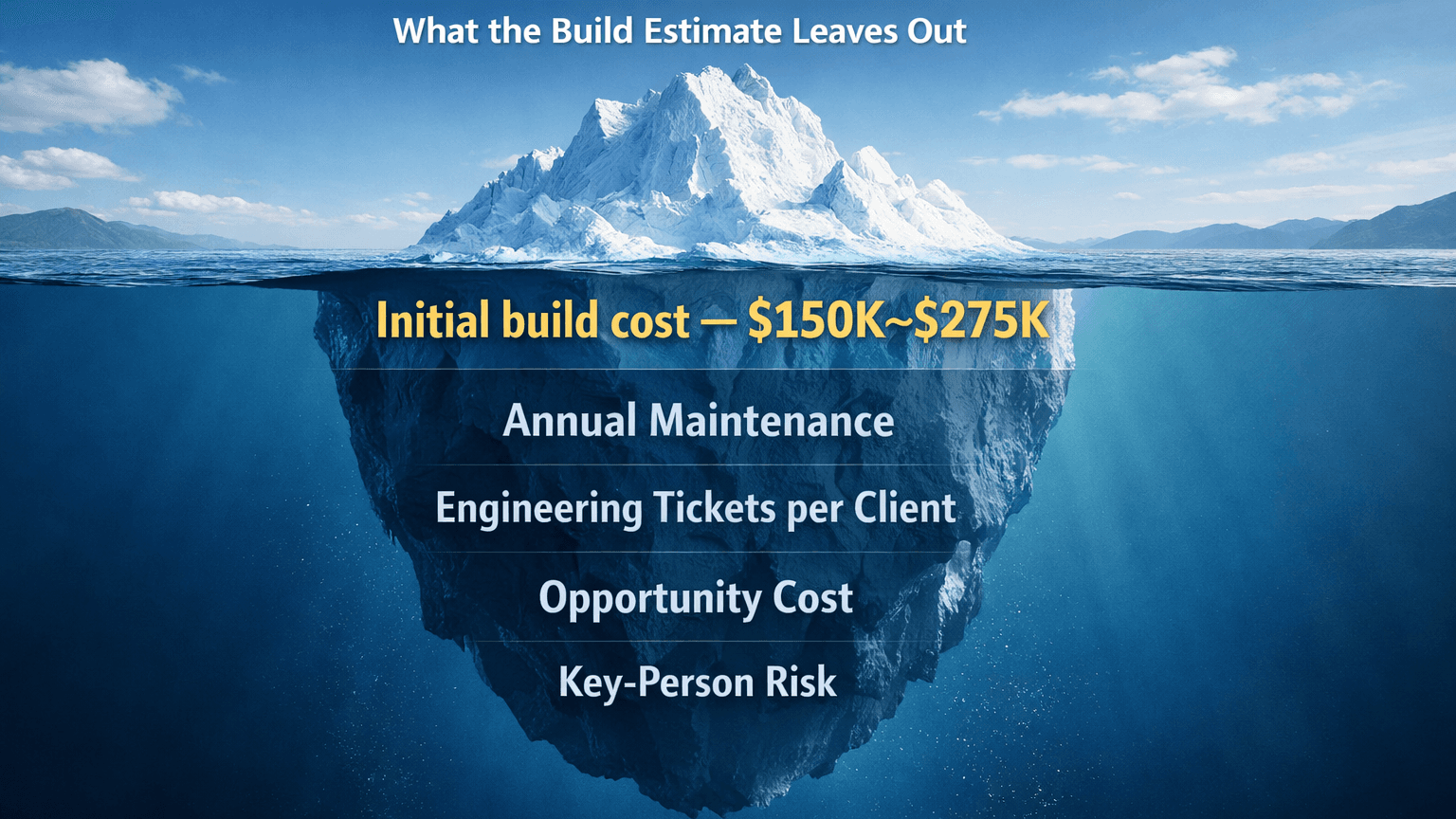
Based on Bureau of Labor Statistics wage data, practitioner build accounts, and IEEE software maintenance research, building a production-quality embedded CSV importer costs between $150,000 and $275,000 in initial engineering labor. This assumes two mid-to-senior engineers over 3-6 months, which is the range documented across multiple independent practitioner accounts. Patrick McKenzie (patio11) estimated $100,000 for a basic implementation; a production-grade importer with validation, error UI, transformation logic, and multi-tenant configuration runs higher. These figures use fully-loaded engineering costs at $110-$145 per hour, derived from BLS Occupational Employment Statistics with a 1.35x overhead multiplier for taxes, benefits, and related costs.
Practitioner accounts consistently show that data importer builds take 3-6 months with two engineers, regardless of initial estimates. A OneSchema survey found that teams projecting 1-3 months typically delivered in 3-6 months, a systematic 2x underestimate. Individual examples: Staircase AI estimated one month and spent one year. Affinity ran four separate engineering projects over two years. Patrick McKenzie delayed building the feature for four years because he estimated $100,000 in engineering time just to do it well. The cause is documented: engineers estimate for the happy path and miss the long tail of file format edge cases, encoding variations, validation rules, and error handling requirements that production files introduce.
No. Flatfile and OneSchema handle the file upload interface and basic column mapping, but transformation logic beyond simple column renaming still lives in your application code. When a client changes their file format or when business rules change, your engineers write code and deploy a fix. The license fee replaces the cost of building the upload UI, not the cost of maintaining transformation logic. DataFlowMapper is different because it externalizes the entire transformation layer into versioned template files managed outside your codebase. After the SDK is embedded, format changes and business rule updates are template edits made by admins, not engineering tickets.
IEEE research finds that software maintenance typically exceeds 50% of total lifecycle cost. For a data importer, annual maintenance typically runs 75% of the initial build cost per year, based on a OneSchema survey of SaaS engineering teams. The sources of maintenance cost are documented: new client file format variations, encoding edge cases, schema changes requiring updated validation logic, performance issues from growing file sizes, and security patches. Each new client with a different export format adds conditional logic to your codebase. PracticePanther's scripts 'kept breaking' because competitor export formats changed constantly. Heron Data experienced CSV upload issues dozens of times per week, each requiring 30-45 minutes of engineering time.
For a typical SaaS team with two mid-level engineers, the 3-year total cost of building an embedded data importer is approximately $550,000-$850,000. This includes initial build costs of $150,000-$275,000 plus annual maintenance of $75,000-$150,000 per year. This does not include opportunity cost: the roadmap items displaced while engineers build and maintain the importer. Affinity's Director of Engineering said CSV import was one of two features they regretted building in-house, alongside subscription billing. Their team ran four separate engineering projects over two years before leadership ruled CSV import permanently off the roadmap.
Building makes sense in a narrow set of circumstances: your import logic is a genuine competitive differentiator, you have fewer than five clients who will ever use the feature, the file format is completely standardized and will never change, and you have engineering capacity that cannot be better used on your core product. In most B2B SaaS companies none of these conditions apply. Data import is infrastructure, not a moat. The question is not whether you can build it, but whether ongoing maintenance is a better use of engineering time than shipping features that differentiate your product.
The planning fallacy, identified by Kahneman and Tversky in 1979, is the documented tendency to underestimate task completion times based on optimistic scenarios rather than historical evidence. In software, this produces systematic underestimates: research found only 13% of people finish by their 50%-probability estimate. For data importers, the OneSchema survey found actual build times were 2x initial projections across teams. Engineers estimate for the happy path: clean CSV, standard encoding, consistent headers, simple column names. Production files include Windows-1252 encoding, embedded newlines, multi-row headers, EANs in scientific notation, and dozens of other variations that each require handling and testing.
An embedded importer handles the file upload interface and basic column mapping. Flatfile, OneSchema, and Dromo are in this category. A data transformation portal goes further: it includes the transformation logic layer, business rules, reference data lookups, validation, and the ability to reuse all of that logic across subsequent imports from the same source. The key distinction is where business logic lives. With an embedded importer, transformation logic lives in your application code and requires engineering to change. With a data transformation portal like DataFlowMapper, transformation logic lives in template files managed by admins outside your codebase, so format changes never generate engineering tickets.